← Back to the 60-film index CASE 47 / 60 · interview
How AI Helps Solve Medical Mysteries at Boston Children’s Hospital | OpenAI Forum Watch original ↗ Published 2026-08-04 Runtime 39:31 Sampled every 60s ASR · not captions
A participant's diagnostic search gives the research discussion personal stakes. Expert explanations develop reported findings, then audience questions expose unresolved validation and access issues.
Narrative interpretation, grounded in the timed machine transcript and the sampled images below.
Story sequence Editing comparison Timed transcript guide Provenance 01 / STORY SEQUENCE
What the film sets up, shows, and resolves These are exact analytical ranges on the source clock, not frame-accurate cut boundaries. A beat may contain several shots. Images are sampled; no continuous viewing or listening pass is claimed.
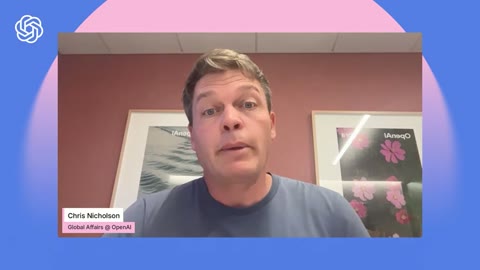
Moderator introduces research and reported diagnostic leads. Sampled visual. Event card, then solo moderator on blue-pink layout.
Edit observation. Portrait roster gives way to one enlarged webcam.
Window 0.000s–104.000s · visual sample 60.500s
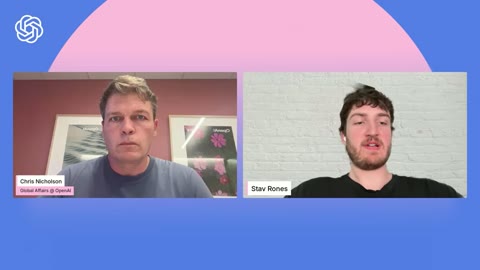
Participant recounts delays and diagnosis's personal consequences. Sampled visual. Moderator and participant in paired webcam boxes.
Edit observation. Stable two-person arrangement keeps interviewer and subject visible.
Window 104.000s–335.000s · visual sample 240.500s
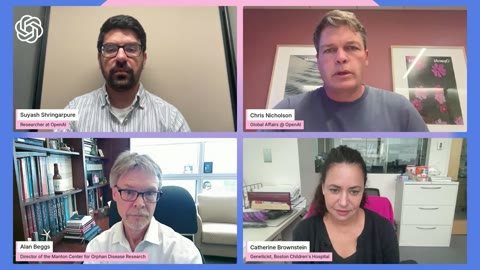
Experts describe analysis burdens and family experiences. Sampled visual. Four labeled webcams in a fixed grid.
Edit observation. Panel replaces the pair; positions persist across samples.
Window 335.000s–967.000s · visual sample 540.500s
Researchers explain filtered inputs, hypotheses, and expert checking. Sampled visual. Same four-person grid; no workflow diagram sampled.
Edit observation. Explanations change without a sampled layout reset.
Window 967.000s–1405.000s · visual sample 1200.500s
Reported diagnoses differ from exploratory leads; access remains unfinished. Sampled visual. Panelists remain visible together.
Edit observation. Shared grid persists through results and deployment discussion.
Window 1405.000s–1765.000s · visual sample 1500.500s
Speakers discuss reanalysis hopes, unsolved cases, and funding provenance. Sampled visual. Four webcams against unchanged event graphics.
Edit observation. No sampled visual separation distinguishes forecasts from findings.
Window 1765.000s–1995.000s · visual sample 1860.500s
Audience questions probe sequencing, missed patterns, and reasoning versus curation. Sampled visual. Panel grid; no question cards sampled.
Edit observation. Question changes are carried by ASR, not new graphics.
Window 1995.000s–2295.000s · visual sample 2220.500s
Moderator thanks participants and promotes continuing research. Sampled visual. Solo moderator enlarged within the event frame.
Edit observation. Single webcam replaces the preceding panel sample.
Window 2295.000s–2371.300s · visual sample 2340.500s
02 / SOURCE COMPARISON
One editing mechanism to study 60.000s–421.000s · Compare with the original ↗
60.500s · Source sample, not a measured cut.180.500s · Source sample, not a measured cut.360.500s · Source sample, not a measured cut.Observed Solo moderator becomes a participant pair, then a four-person expert grid.
Interpretation Interpretation: personal consequences precede technical breadth.
Try with your own footage Introduce a real user, explore their difficulty, then widen to responsible specialists.
Do not overread it Minute sampling cannot establish handoff timing; panel testimony does not validate diagnoses.
03 / TRANSCRIPT GUIDE
Follow the argument on the source clock This is a paraphrased index, not a verbatim transcript. Full ElevenLabs ASR stays in the local research bundle. No publisher captions are presented here. Links open the official source, rounded down to a whole second; exact returned ASR anchors are listed separately. 6,644 machine-recognized words.Source range Paraphrase + speech anchor 0:00–1:44 ↗ Moderator introduces research and reported diagnostic leads.ASR word start 9.680s 1:44–5:35 ↗ Participant recounts delays and diagnosis's personal consequences.ASR word start 105.720s 5:35–16:07 ↗ Experts describe analysis burdens and family experiences.ASR word start 482.020s 16:07–23:25 ↗ Researchers explain filtered inputs, hypotheses, and expert checking.ASR word start 997.167s 23:25–29:25 ↗ Reported diagnoses differ from exploratory leads; access remains unfinished.ASR word start 1431.328s 29:25–33:15 ↗ Speakers discuss reanalysis hopes, unsolved cases, and funding provenance.ASR word start 1765.500s 33:15–38:15 ↗ Audience questions probe sequencing, missed patterns, and reasoning versus curation.ASR word start 2004.208s 38:15–39:31 ↗ Moderator thanks participants and promotes continuing research.ASR word start 2323.124s
04 / EVIDENCE BOUNDARY
What was checked Primary source Official OpenAI channel · SJJBPwlPpww ↗ Acquired 2026-09-17T18:16:26.416550+00:00 · 854 × 480 research rendition Publication basis playerMicroformatRenderer.publishDate · 2026-08-04T13:29:24-07:00 Media SHA-256 858aab20c499872aeb07b75965a521c966a4c1c970b0127c0bba3880fb73300b Transcript ElevenLabs scribe_v2 · ASR unverified · audio-to-source offset 0.000000s. Actual returned timing, not text-length estimates. Visual review 2 contact sheets · 60-second stills and complete unverified ASR only; analytical windows, not continuous playback. Case limitation Minute gaps conceal edits; medical findings remain speaker-attributed, including unresolved leads. Rights Short discussed stills credited to OpenAI. Zero transcript words quoted. Research evidence is not a licensed asset library for new films. ← Introducing Agent Plugins Meet Birding Pal →